HM Eterno Yelahanka master plan image
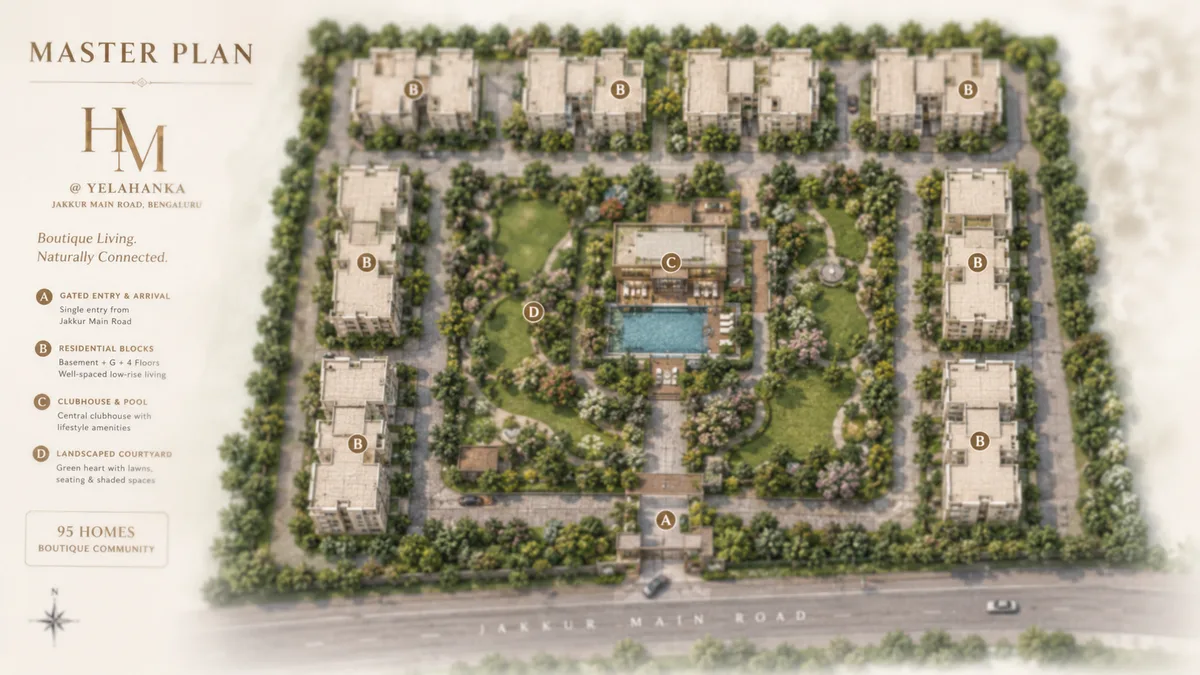
HM Eterno Yelahanka's master plan is organised around a single governing idea: low density. The community of 95 homes is built as Basement + Ground + 4 floors, with only two apartments per floor, arranged as a small cluster of low-rise blocks set into landscaped open space on Jakkur Main Road, Yelahanka. The site measures 1.2 acres. The precise site geometry and block count are set out in the official master plan and the K-RERA filing; the framework below describes the design intent and the structural logic of a Basement + Ground + 4, two-per-floor community.
The low-density logic
The defining number at HM Eterno Yelahanka is two apartments per floor. Across a Basement + Ground + 4 built form, that works out to roughly eight to ten homes per block, so the 95-home community is composed of a small set of low-rise blocks rather than one or two dense towers. This single decision shapes the entire master plan.
In a high-rise township, the buildable footprint is concentrated into a few tall towers, and the open space is what remains around their base - often a podium deck stacked above the parking. In a boutique low-rise like HM Eterno Yelahanka, the built form is spread horizontally across low blocks, and the open space is woven between them at the ground plane. The practical effect is that residents live close to the garden rather than forty metres above it, that light and cross-ventilation reach every home because the blocks are low and well-spaced, and that the community never feels like a crowd.
The low height also simplifies the building services. A four-floor block needs modest lift and pumping infrastructure compared with a high-rise, the fire-and-life-safety systems are simpler, and the whole development's services are sized for 95 homes. That proportionality is one of the practical advantages of the boutique format - a smaller community places a lower absolute load on every shared system, which supports the monthly running cost.
| Parameter | Value |
|---|---|
| Total homes | 95 |
| Built form | Basement + Ground + 4 floors |
| Density | 2 apartments per floor |
| Configurations | 2 & 3 BHK (Vaastu-compliant) |
| Unit sizes | 2 BHK 1,100 - 1,300 sq ft; 3 BHK 1,511 - 1,830 sq ft |
| Parking | Covered, across Basement and Ground |
| Lift access | In every block |
| Entry | Single gated point on Jakkur Main Road |
Site organisation and block placement
The blocks at HM Eterno Yelahanka - each Basement + Ground + 4, two homes per floor - are arranged to maximise the landscaped open space between them and to give every home good orientation and outlook. The design intent is a garden community with buildings set into it: the blocks frame internal courtyards and greens rather than standing as isolated towers in a car park.
The Vaastu-compliant orientation of the homes is carried through at the site level. Because the whole project is planned to Vaastu principles, the blocks and the open spaces are arranged so that the standard Vaastu placements - entrance orientation, kitchen and master-bedroom direction, puja-space placement - fall naturally into the individual units. This is the advantage of designing to Vaastu from the master-plan stage rather than retrofitting it onto a finished layout.
The boutique clubhouse and the swimming pool form the social heart of the community, positioned centrally so that they are equally accessible from every block. The central landscaped courtyard sits at the core, with the children's play area, the senior citizens' court, and the open greens distributed around it.
Open space and landscape
In a low-rise community, the open space is the experience. HM Eterno Yelahanka's landscape strategy distributes greenery across the ground plane in three layers:
- Central courtyard and greens. A landscaped courtyard at the core of the community, planted with shade and ornamental species, with seating and lawn - the daily-hangout space for residents.
- Inter-block landscape. Planted strips and pathways between the low-rise blocks, which keep the spacing generous and give every home a green outlook rather than a wall.
- Perimeter landscape. A planted edge along the boundary that buffers the community from the road and frames the arrival sequence.
Because the blocks are only four floors high, the landscape reads at human scale - residents walk through a garden between buildings, not across a podium deck under towers. The walking and jogging path threads through this landscape, connecting the clubhouse, the pool, and the courtyard.
Vehicular and pedestrian circulation
HM Eterno Yelahanka uses a single gated entry point on Jakkur Main Road, which consolidates security to one boom barrier, one guard cabin, and one CCTV cluster - a layout that is both simpler and easier to operate than a multi-gate township. Covered parking is distributed across the basement and ground levels, with the parking accessed via ramps from the entry, and the upper-floor homes reached by lift in every block.
Inside the community, pedestrian movement is kept separate from the driveways. Residents move between the blocks, the clubhouse, the pool, and the courtyard along landscaped pedestrian paths that do not cross the vehicle routes. The low density helps here too - with 95 homes and covered parking, the internal vehicle movement is light, and the pedestrian environment stays calm.
- Entry / exit: Single gated point on Jakkur Main Road
- Parking: Covered, across Basement and Ground levels
- Vertical circulation: Lift access in every block
- Pedestrian network: Landscaped paths separated from driveways
- Security: Single-point gated access with CCTV and visitor management
The boutique clubhouse and amenity placement
The boutique clubhouse is positioned at the centre of the community, equally reachable from every block, with the swimming pool adjacent. The clubhouse houses the indoor amenities - the gymnasium and fitness studio, the indoor games room, the reading lounge, the multipurpose / community hall, and the yoga and meditation deck - in a single social hub.
The decision to scale the amenities to the community is deliberate. A 95-home community does not need a township-scale amenity sprawl where most facilities sit idle; it needs a curated set that residents actually use. The clubhouse, the pool, the gym, and the courtyard are sized so that they feel available rather than crowded - one of the practical benefits of the boutique format. The amenity placement at the core also means short walks from every block, which is part of what makes the amenities part of daily life rather than an occasional destination.
| Amenity zone | Placement |
|---|---|
| Boutique clubhouse (indoor amenities) | Central social hub |
| Swimming pool | Adjacent to the clubhouse |
| Central landscaped courtyard | Core of the community |
| Children's play area | Near the courtyard / greens |
| Senior citizens' court | Quiet zone away from active play |
| Walking / jogging path | Threaded through the landscape |
| Covered parking | Basement and Ground levels |
Below-ground and services infrastructure
The basement level carries covered parking and the community's core services, sized for a 95-home development:
- Domestic water tanks and pump rooms supplying the blocks
- Fire-fighting tanks and pumps meeting Karnataka Fire Services requirements
- Sewage Treatment Plant (STP) sized for the community, with treated water reused for landscape irrigation
- Rainwater harvesting pits and recharge capturing roof and surface runoff
- Electrical infrastructure and power-backup (DG) provision for homes and common areas
- Organic waste management for on-site processing of wet waste
The services are arranged so that the mechanical noise and the waste handling are kept away from the homes and the social spaces. Again, the low density helps - a smaller community means smaller tanks, fewer pumps, and a lighter load on every system, which keeps both the running cost and the environmental footprint proportionate.
Sustainability at the site level
HM Eterno Yelahanka's master plan integrates the sustainability features expected of a premium Bengaluru community:
- Rainwater harvesting to recharge groundwater
- STP with treated-water reuse for landscape irrigation, reducing fresh-water draw
- Organic waste management to process wet waste on site
- Distributed landscape across the ground plane, which keeps the site cooler and greener than a podium-and-tower layout
- Pedestrian-vehicular separation that reduces tailpipe exposure in the resident areas
The cumulative effect of a low-rise, low-density layout with distributed landscape is a community that runs cooler, greener, and on a lower per-home services load than a comparable high-rise development of similar quality.
Master plan key highlights
The test of a master plan is the experience it produces. At HM Eterno Yelahanka, the low-rise blocks, the distributed landscape, the central clubhouse and pool, and the single quiet entry combine to produce a community that feels like a garden address rather than a vertical township. Residents arrive through a gated, landscaped entry; park in covered basement or ground parking; and walk through greenery to reach a home that is never more than four floors up, on a floor shared with just one other family. That is the boutique proposition made physical - and it is the reason the master plan, with only 95 homes and two apartments per floor, is the core of what HM Eterno Yelahanka offers on the Yelahanka-Jakkur corridor.
HM Eterno Yelahanka master plan FAQ
How is the HM Eterno Yelahanka master plan organised?
The master plan is organised around low density. The 95 homes are built as Basement + Ground + 4 floors with only two apartments per floor - roughly eight to ten homes per block - so the community is a small cluster of low-rise blocks set into landscaped open space rather than one or two dense towers. The boutique clubhouse and the swimming pool form the social heart at the centre, with the central landscaped courtyard at the core.
What is the built form at HM Eterno Yelahanka?
Basement + Ground + 4 floors, with two apartments per floor. The basement and ground levels carry covered parking; the four upper floors carry the homes, two per floor, with lift access in every block. Because the built form is low and the blocks are well-spaced, light and cross-ventilation reach every home and the open space reads horizontally at the ground plane rather than as a podium deck.
How is vehicular and pedestrian movement handled at HM Eterno Yelahanka?
HM Eterno Yelahanka uses a single gated entry point on Jakkur Main Road, which consolidates security to one boom barrier, one guard cabin, and one CCTV cluster. Covered parking is distributed across the basement and ground levels, accessed via ramps from the entry. Inside the community, pedestrian movement along landscaped paths is kept separate from the driveways, and the low density keeps internal vehicle movement light.
Where are the amenities placed on the HM Eterno Yelahanka master plan?
The boutique clubhouse is positioned centrally so it is a short walk from every block, with the swimming pool adjacent and the central landscaped courtyard at the core. The children's play area, the senior citizens' court, and the open greens are distributed around the courtyard, and the walking / jogging path threads through the landscape connecting the clubhouse, the pool, and the courtyard.
What below-ground and sustainability infrastructure supports HM Eterno Yelahanka?
The basement level carries covered parking and the community's core services, sized for 95 homes: domestic water tanks and pump rooms, fire-fighting tanks and pumps, a Sewage Treatment Plant with treated-water reuse for irrigation, rainwater-harvesting pits and recharge, electrical and power-backup provision, and organic waste management. The low density keeps the absolute load on every system - and the running cost - proportionate to a small community.
Talk to the HM Eterno Yelahanka team
Request the master plan, the floor plans, and a site-visit slot on Jakkur Main Road, Yelahanka.
Contact us